|
 |

|
|
November / December 2002 - Food for Thought
Click on a link below to jump to an article:
Milk: Does it "do a body good?" The rest of us are caught in the middle, trying to figure out whether the cream in our coffee will send us to an early grave, whether drinking milk causes or cures diseases, and, most importantly, whether humans even have any business at all suckling off a bovine. What is the milk debate teaching us? In a nutshell, milk is great for some, bad for others, and simply not necessary for most of us. It has to do with milk protein, milk sugar and the propensity of dairy products to cause allergies and metabolic changes in the human body. Moreover, milk isn�t just milk anymore. In addition to concerns about saturated fat and the ethics of large-scale dairy operations, there is now �junk� in our milk in the form of hormones and antibiotics. May as well light up Dr. Neil D. Barnard, president of the Physician�s Committee for Responsible Medicine (PCRM), a group strongly opposed to the dairy industry, believes Americans need to re-think what it means to consume dairy products.
�We should think of drinking milk the way we think of smoking cigars,� says Barnard said. �Some people like it, some hate it, but it is not necessary and, in fact, carries health risks that people need to be aware of.� What are those health risks? According to studies cited by the PCRM, milk fat and protein are linked to prostate cancer, juvenile diabetes, arthritis, heart problems, milk allergy in young children and gastrointestinal problems in people with lactose intolerance. Also, milk can be contaminated with blood, pus and agricultural contaminants from the cows themselves, not to mention bovine growth hormones and antibiotics. All milk that is not labeled hormone and antibiotic free contains FDA-approved hormones developed to increase milk production in dairy herds. The biggest concern about Bovine Growth Hormone (commonly known as rBGH) is that it elevates the insulin-dependent growth factor 1 protein (IGF-1) in milk. Elevated levels of this protein in the human body are linked in numerous studies, including the Harvard Physicians' Health Study and the Nurses' Health Study, to increased risk of prostate cancer in men and breast cancer in women. However, IGF-1 does occur naturally in humans and is actually more concentrated in human breast milk than in cow milk. Also, it is not considered a risk (based on current research) when consumed in the form of yogurt, cheese or ice cream. And while some studies link high levels of IGF-1 to milk consumption, others show little or no correlation. The health branch of the Canadian government rejected the use of growth hormones to boost milk production in that country, but cited concerns about the hormone�s effect on cows (mastitis, lameness and other disorders) as main concerns. Bone to pick Why consume milk at all? One of the biggest reasons cited, especially for women, is that it is a convenient source of protein and calcium. Adequate calcium is essential for preventing osteoporosis. And pregnant women are advised to consume even more to prevent the fetus from taking calcium from the mother�s bones. But the calcium in milk may not do as much for our bones as we�ve been led to believe. The extensive �Harvard Nurse�s Study� completed in 1997 found that calcium consumed in the form of milk did not affect incidences of fractures. In fact, even after adjustments for age, weight, menopause and other factors, of the 78,000 women who took part in the study, researchers discovered those who consumed the most milk had the most fractures. Ironically, people who consume little or no milk have the strongest bones. But it may not be milk that is the problem. Diets high in animal protein, it turns out, along with those high in sodium, cause calcium to be excreted in the urine. Saroja Koneswaran, M.D, a Connecticut physician, points out that American culture, unlike modern milk, is not homogenous. Writing on behalf of the PCRM, she touches on the fact that people of Asian descent, many of whom have lactose intolerance and do not consume any milk at all, have little to no incidences of osteoporosis. �Ideal calcium intake may differ by ethnic group, but it is no secret we all need some calcium,� writes Koneswaran. �What the [USDA] Guidelines neglect to emphasize are alternative, superior calcium sources. For instance, the calcium absorption rates of some green leafy vegetables top 50 percent. Beans and fortified orange juice are other rich calcium sources. Milk, by contrast, has an absorption rate of only 32 percent. This rate does not even take into account the presence of animal protein and sodium in milk, both of which lower calcium retention.� Tofu, seaweed and soy beverages are all excellent sources of non-dairy calcium with higher absorption rates than milk. However, some vegetables high in calcium, such as spinach, contain acids that prevent calcium absorption. The trick, say researchers at Cornell University in New York, is to get the most out of the calcium that you do consume, no matter the source. A series of studies as part of the Cornell-China-Oxford Project on Nutrition, Health and Environment, by nutritional biochemist T. Colin Campbell and his colleagues, show that reducing the amount of meat in the diet can have a greater effect on reducing osteoporosis than consuming more calcium. The study explains that hip fracture rates in China are five times less than fracture rates in the U.S. The Harvard School of Public Health reports that excessive sodium intake and inadequate consumption of Vitamin D, A and K also negatively affect calcium absorption. In addition, Harvard health experts say getting adequate amounts of weight-bearing exercise is crucial for building and maintaining good bone density. Another problem Protein In New Zealand, Dr. Corran McLachlan, a chemist and chemical engineer, runs the A2 dairy company. McLachlan raises cows that produce milk free of the protein beta casein A1, a substance suspected by McLachlan and his partners of causing heart disease. Certain cows, such as Guernsey cows, produce milk without the A1 protein. Cattle raised by the African Masai tribe (where coronary disease is low) also do not produce the A1 protein. McLachlan supports his findings with worldwide statistics relating high levels of A1 protein in milk to heart problems. For instance, Finland reports the highest coronary heart disease in the world and consumes the most A1 milk. When comparing populations with similar heart disease risk factors, McLachlan found that those who consumed more A1 milk had higher incidences of the disease. Studies also show that beta casein A1 can keep IGF-1 levels elevated in the blood longer. Leave the cows in the field and forage for bitter herbs There is another dimension to this story: Scientists are discovering that when it comes to the classic American diet, it isn�t always what we eat, but what we don�t. For example, in Crete, where men live longer than in any other country on earth, nutrition comes from a variety of local foods such as goat cheese, seafood, red wine and olive oil - gallons of red wine and olive oil. But here�s the important part: A Cretan, on average, consumes more than a pound of fresh fruits and vegetables every single day, including lots of wild greens and herbs. They don�t eat butter. And they eat fresh fruit for dessert - very little refined sugar. (Baklava, by the way, is a modern invention, not a traditional Cretan food). Similarly, the French, who consume more dairy products than any other people in the world (mostly in the form of cheese), have much better heart health than Americans. But the French, like the Cretans, also consume large quantities of fresh fruits and vegetables, and wash it all down with plenty of heart-healthy red wine. It is also important to note that the French have a relaxed attitude about food and body image. They eat three meals a day with little or no snacking between meals, with lunch being the biggest meal of the day. According to Web MD, an Internet medical site, one study of French eating habits showed that the French consume 60 percent of their total daily calories before dinner, and they average less than one snack per day. Also, the French report an 8 percent obesity rate compared to a whopping 33 percent in the United States. Conversely, in Africa, the Masai tribe consumes almost nothing but fresh and curdled milk, cow�s blood, sheep and goat flesh, and honey. However, tribespeople also eat unprocessed grains and make a traditional soup by boiling water in a bowl carved out of the acacia tree. The broth contains high levels of saponin, a powerful antioxidant also found in soy products and green tea. They also do not consume refined sugar. Experts believe this, along with genetics, allows them to consume milk protein; and high levels of outdoor exercise contribute to the Masai�s low levels of heart disease and cholesterol problems, diabetes and other debilitating diseases. Read all about it Don�t just take my word for it. Find out more about milk for yourself through the following books and Internet sources: Internet sources: National Dairy Council: www.nationaldairycouncil.org WebMD: www.webmd.com Harvard School of Public Health, �Calcium & Milk�: www.hsph.harvard.edu/nutritionsource/calcium.html University of Guelph, Canada Dairy Science and Technology Page: www.foodsci.uoguelph.ca/dairyedu/home.html Books: Milk, The Deadly Poison, by Robert Cohen, Argus Pub, 1998. The Lactose Free Cookbook, by Sheri Updike, Warner Books, 1998. NG
Breaking bread
Community kitchens are about much more than food
Food has the power to inspire, to nurture, to build and sustain health, and to fulfill deep social and cultural needs by bringing families and communities together. In this era of convenience, the connection between food and family is being lost as people abandon the traditional family meal in favor of fast foods and eating on the run. Community kitchens are changing that by providing a way to reconnect communities with food.
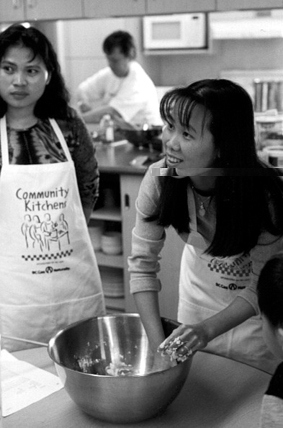
Influenced by a long history of communal cooking around the world, community kitchens bring together a group of individuals who gather on a regular basis to cook together, to share meals, and to build community. Based on the goal of creating an atmosphere of sharing, members have the opportunity to meet diverse groups of people and learn new skills while preparing communal meals. Community kitchens serve up an experience where all participants enjoy the good food and rich social benefits of their efforts.
Diane Collis, VCKP coordinator says she witnessed the power food has to make a difference in people�s lives while working with an organization that provided free meals to people living with HIV/AIDS in the greater Vancouver area. Determined to make a difference through an organization that provides a �hand-up� instead of a handout, Collis joined the VCKP in 1998, and her efforts are directly responsible for much of the community cooking that is taking place throughout Vancouver.
A large part of Collis� role as coordinator is bringing people together who are interested in starting or joining a community kitchen. Collis says women are especially eager to connect with one another over food and comprise 80% of community kitchen members. �The connection between women and food is undeniable,� says Collis. �In most cultures women are responsible for feeding their families. Community kitchens are very multicultural, but these women all share the cultural connection of providing food.�
Collis admits that for most women the community kitchen is about a lot more than food. �It�s about more than food or money or improved health,� she says. �It�s the social benefits that keep the kitchen going. Community kitchens rely on people participating in every stage of the kitchen from planning and finances, to shopping and preparation. For a lot of people, a community kitchen is their first experience with community organizing, and the community and individual capacities a community kitchen builds are very empowering.�
Thirty-two-year-old cancer researcher, Cristina Tognon, says that the vegetarian community kitchen she co-founded is so passionate about community they have created a mandate to participate in at least one volunteer event each year dealing with vegetarian cooking. To date, the group of eight women, ranging in age from 26-60, has hosted an open house for other community kitchens, donated vegetarian food for a school festival, and prepared healthy snacks for a daycare and a senior�s center.
Tognon�s group gathers one Wednesday every month in the home economics classroom of a local school to prepare vegetarian meals. �I love to cook, and I love community, so the two just jived with me,� says Tognon of her motivation to join a community kitchen.
In Tognon�s community kitchen, members take turns choosing recipes and creating a master grocery list. Each member is responsible for purchasing a few of the ingredients for the upcoming cooking session. Members work together to prepare a meal, which often consists of several different vegetarian dishes, and then they sit down together to share their mouthwatering culinary creations.
Tognon says the benefits of belonging to a Community Kitchen are numerous. In addition to being introduced to new recipes that she might shy away from at home, Tognon says community kitchens are appealing because of the financial benefits. For a single cooking session, where members prepare 6-7 recipes, the cost per member ranges from $7-$12, which includes a huge meal the night of the cooking and enough food to take home for several days.
While tasty meals at a fraction of the cost make community cooking attractive to many members, Tognon says it is the member-driven spirit of the kitchen that is one of the biggest benefits. �I love the women in my kitchen,� she says, �they are all so strong and inspiring. When we cook together we talk and share things about our lives. It�s an incredible way to learn from other women.� Tognon adds that, �one of the greatest things about this type of program is that many of the kitchens are self-running, meaning we don�t use government money or require someone to run the program. As a group we decide what we want, and we create it.�
It was this spirit of creating a self-running program that compelled Ellen Wickberg into action more than twelve years ago. When the women�s center where Wickberg taught community nutrition to Native women closed its doors, she was determined to secure funding to continue teaching these women about canning and preserving foods. With a $500 grant in-hand, Wickberg began a community canning kitchen. Today the 69-year-old semi-retired community nutritionist still meets weekly with a diverse group of women to preserve foods that might otherwise go to waste.
Of the eight members in the canning kitchen, ranging in age from 17-87, Wickberg is the only original member. Most of the women are native Canadians or newcomers to Canada from countries like Peru, Hong Kong, Vietnam and East India. Although the group is diverse, the women who attend the community kitchen each week share a love of food and a desire to learn more about preserving.
Unlike most community kitchens where members meet only once a month, members of the canning kitchen meet weekly for four hours at Kiwassa, a local community center. Kiwassa, the women�s division of Kiwanis, an international community service organization, generously donates space to the community kitchen and provides free childcare for members. This makes the canning kitchen accessible to a more diverse group of women. Kiwassa also donates a great deal of food from their on-site food bank to the kitchen. In fact, most of the food and supplies used by the canning kitchen are donated. Wickberg says the large numbers of donations they receive, ranging from canning jars to food, means members rarely have to contribute financially toward their cooking sessions.
Determined not to let foods go to waste, the canning kitchen has developed special recipes to ensure that they are able to use every donation of food they�re given. �The food bank was given a donation of frozen, sliced yellow peppers they couldn�t distribute,� says Wickberg, �so we developed a recipe for yellow hothouse pepper jam to make sure they didn�t go to waste.�
According to Wickberg, part of the appeal of the canning kitchen is helping women expand their culinary interests in a hands-on environment. With women from so many different countries working together, there is never a shortage of new foods to try. The community kitchen also allows women from diverse backgrounds to build bonds of friendship they wouldn�t have access to in their day-to-day lives, which, in turn, builds their self-esteem. Wickberg tells the story of a Native woman in the canning kitchen who gave her sister-in-law a jar of blackberry jam she�d made herself. �It was the first time she�d given something of value, instead of being the recipient,� says Wickberg, �and this is true for so many low-income women.�
Women who participate in the community kitchen gain self-esteem in many ways. For example, a large number of the women who participate in the canning kitchen are immigrants and many have limited English skills; but, Wickberg says, they still actively contribute to the kitchen. �There is a Chinese woman who speaks little English in our kitchen. She is a great cook but also has excellent knife skills. She has been teaching other women to sharpen their knife skills through demonstration,� says Wickberg. �When we needed a new set of knives, she volunteered to go out and get them for us. She had gained so much self-confidence in the kitchen that she was able to venture out and negotiate a great deal on a wonderful set of knives.�
Whether the women who are joining community kitchens are looking to learn to cook new foods, make new friends, or be part of a dynamic community organization, the time these women devote to the community kitchen is a gift to the community and to themselves. �One of the members in our kitchen is a new immigrant from Hong Kong,� says Wickberg. �She told me, �everything else I do for my kids; the community kitchen is for me.��
Perhaps most importantly, says Collis, �community kitchens are valuable because they are very tangible. They help feed people and bring dignity to the way people feed themselves. Community kitchens feed the soul as much as they feed the stomach.�
For more information on the Vancouver Community Kitchen Project, or to order Many Hands: Community Kitchens Share Their Best, visit http://www.communitykitchens.ca.
NG
|
||||
|
|
Archives |
Distribution |
Order Copy |
News |
About NG! |
Site Map |
Webmaster
ISSN 1536-9897 Copyright 2002 by Nervy Girl!, LLC. All rights reserved. Reproduction without permission is prohibited. td> |

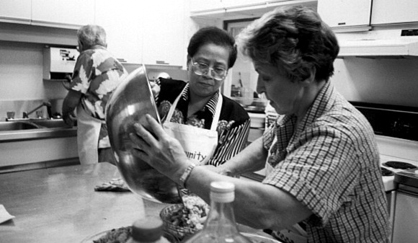 (Photos courtesy of Vancouver Community Kitchens)